

Table of Contents
The Oxygen Gap: Why 21% O2 at 1 ATM is a Bottleneck for Brain Repair
The human brain represents approximately 2% of total body weight yet consumes roughly 20% of the body’s oxygen supply. This metabolic demand is constant, leaving the central nervous system (CNS) uniquely vulnerable to even minor fluctuations in oxygen availability. Under standard physiological conditions—1.0 Atmosphere Absolute (ATA) while breathing 21% oxygen—the brain operates within a narrow margin of efficiency. This is the “Oxygen Gap.”
The primary limitation of our respiratory system is not the capacity of our lungs, but the transport mechanism of our blood. In a normobaric environment, oxygen transport relies almost exclusively on hemoglobin. Once hemoglobin is saturated—typically at 97-99% in a healthy individual—breathing more oxygen at sea level provides negligible benefits. The system is maxed out.
For the high-performance individual or the patient recovering from neuro-inflammation, this cap is a structural failure. When brain tissue is injured, whether through traumatic brain injury (TBI), stroke, or the chronic degradation of aging, the resulting edema (swelling) increases the distance between capillaries and the cells they serve. This increased diffusion distance creates “hypoxic zones” where oxygen cannot reach, effectively halting the cellular repair processes necessary for cognitive maintenance.
To bridge this gap, we must move beyond the limitations of red blood cell transport. We need a method to force oxygen into parts of the body that hemoglobin cannot reach. This requires a shift from biology to physics.
The Physics of 2.0 ATA: Henry’s Law and Plasma Dissolution
To understand clinical HBOT, one must distinguish it from the “soft chambers” often found in wellness spas. These inflatable bags typically reach 1.3 ATA, a pressure insufficient to trigger the physiological shifts required for neuro-regeneration. At Havena, we operate at 2.0 ATA—the clinical threshold where the laws of physics begin to override the limitations of biology.
The Mechanics of Henry’s Law
The foundational principle of HBOT is Henry’s Law, which states that the amount of a gas dissolved in a liquid is proportional to its partial pressure. Under normal conditions, oxygen is barely soluble in blood plasma; it is tucked away inside hemoglobin. However, when a subject is placed in a hard-shell chamber at 2.0 ATA and administered 100% oxygen, the partial pressure of oxygen in the lungs increases nearly tenfold.
Bypassing Hemoglobin
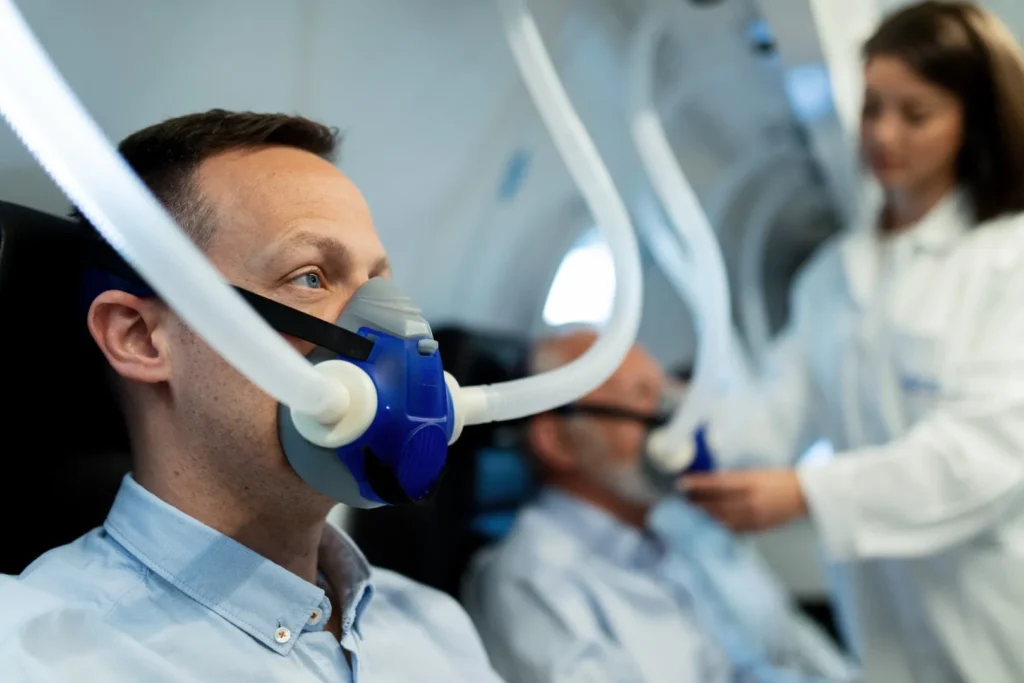
At 2.0 ATA, oxygen is driven directly into the blood plasma, the cerebrospinal fluid, and the lymphatic system. This creates a state of hyperoxia. The oxygen levels in the plasma become high enough to sustain life even in the absence of red blood cells.
From a cognitive perspective, this is a force multiplier. Plasma can navigate constricted micro-vessels and cross the blood-brain barrier with far greater ease than bulky red blood cells. By saturating the plasma, we provide the brain with a “super-highway” of fuel, bypassing the traffic jam of damaged vasculature. This is not merely “breathing better”; it is a systemic saturation that changes the chemistry of the internal environment.
Neuro-Regeneration: Angiogenesis and Stem Cell Mobilization
The cognitive benefits of 2.0 ATA HBOT extend far beyond the immediate oxygenation of tissue. The real value lies in the downstream biological signaling triggered by the intermittent hyperoxic-hypoxic paradox. By cycling between high-pressure oxygen and normal air, we trick the body into a massive regenerative response.
Angiogenesis: Rebuilding the Infrastructure
Chronic cognitive decline is often a result of “rarefaction”—the thinning of the capillary networks in the brain. Without adequate blood flow, neurons starve. HBOT at 2.0 ATA stimulates angiogenesis, the formation of new blood vessels. The high pressure increases the expression of Vascular Endothelial Growth Factor (VEGF), essentially “re-wiring” the brain’s plumbing. Over a course of 40 to 60 sessions, the brain develops a denser, more robust vascular network, providing a permanent upgrade to its metabolic capacity.
CD34+ Stem Cell Mobilization
Perhaps the most significant discovery in hyperbaric medicine is the mobilization of stem cells. Research has demonstrated that a single session at 2.0 ATA can double the number of circulating CD34+ pluripotent stem cells. After 20 sessions, these levels increase by eightfold.
These stem cells are the body’s repair crew. In the context of the brain, they migrate to areas of injury or inflammation, differentiating into the cells needed to repair the neural architecture. This is a critical distinction between HBOT and pharmacological interventions; we are not merely masking symptoms, we are providing the raw materials and the signaling environment for structural repair.
The Israel Studies: Reversing the Aging Clock
The most rigorous data supporting HBOT for cognitive enhancement comes from the Sagol Center for Hyperbaric Medicine at Shamir Medical Center in Israel. Their research has challenged the long-held belief that cognitive decline is a one-way street.
Telomere Lengthening
In a landmark 2020 study, researchers found that HBOT at clinical pressures (2.0 ATA) could actually lengthen telomeres—the protective caps at the end of chromosomes—by up to 20%. Additionally, it reduced the population of senescent “zombie” cells by up to 37%. In the realm of longevity science, this is unprecedented. It suggests that HBOT can modulate the aging process at a cellular level, particularly in the highly metabolic tissues of the CNS.
Cognitive Performance Data
Further studies focusing on healthy aging adults showed significant improvements in attention, information processing speed, and executive function following a protocol of HBOT. Utilizing high-resolution perfusion MRI, the researchers documented increased cerebral blood flow (CBF) in specific regions associated with cognitive decline. This confirms that the physiological changes—the angiogenesis and the stem cell mobilization—translate directly into measurable performance gains. For the results-oriented individual, this provides a data-backed roadmap for maintaining peak mental acuity well into later decades.
Stacking Modalities: CGM, Red Light, and Mitochondrial Synergy
At Havena, we view HBOT as the foundation of a broader “Performance Stack.” To maximize the return on investment for cognitive health, HBOT should be integrated with other high-end modalities that address metabolic and mitochondrial health.
CGM Insights (Continuous Glucose Monitoring)
Cognitive function is intrinsically tied to glycemic variability. High blood sugar spikes and subsequent crashes create oxidative stress that can negate the benefits of HBOT. By using a CGM, clients can synchronize their hyperbaric sessions with peak metabolic stability. Furthermore, HBOT has been shown to improve insulin sensitivity. Tracking this via CGM provides a real-time feedback loop, allowing for a precision-medicine approach to brain fuel.
Red Light Therapy (Photobiomodulation)
While HBOT provides the “fuel” (oxygen), Red Light Therapy (RLT) optimizes the “engine” (mitochondria). RLT uses specific wavelengths of light (660nm and 850nm) to stimulate Cytochrome C Oxidase in the mitochondria, increasing ATP production. Stacking RLT with HBOT creates a synergistic effect: HBOT delivers the necessary oxygen to the cell, and RLT ensures the cell uses that oxygen as efficiently as possible. This “Saturation-Utilization” loop is the gold standard for mitochondrial optimization.
PEMF Devices (Pulsed Electromagnetic Fields)
PEMF devices can be used prior to HBOT to improve cellular membrane permeability and microcirculation. By “opening up” the cells with PEMF, the hyper-oxygenated plasma delivered during the HBOT session can penetrate deeper into the target tissues, enhancing the overall efficacy of the treatment.
HBOT vs. Cryotherapy: Systemic Saturation vs. Systemic Shock
It is common in wellness circles to group HBOT with Cryotherapy or Cold Plunges. While both are powerful, they operate on diametrically opposed principles.
Cryotherapy is a “Shock” modality. It triggers a sympathetic nervous system response, inducing the release of norepinephrine and cold-shock proteins. It is excellent for acute inflammation and metabolic “kickstarting.” However, cryotherapy is a vasoconstrictor; it pulls blood away from the extremities and reduces flow to certain tissues to protect the core.
HBOT, conversely, is a “Saturation” modality. It is a parasympathetic-dominant environment that focuses on the deep delivery of nutrients and the long-term rebuilding of tissue. While cryotherapy manages the “fire” of inflammation, HBOT rebuilds the “house” that the fire damaged. For cognitive enhancement, where the goal is the repair of complex neural networks, the saturation of oxygen is a far more essential requirement than the shock of cold.
The 2.0 ATA Standard
The evidence is clear: for those seeking genuine cognitive enhancement and neuro-protection, the pressure matters. “Soft” chambers operating at 1.3 ATA are suitable for general relaxation, but they lack the physical force required to dissolve oxygen into the plasma and trigger stem cell mobilization.
2.0 ATA is the non-negotiable standard for clinical results. By leveraging Henry’s Law to bypass hemoglobin, we can eliminate the Oxygen Gap, trigger angiogenesis, and physically remodel the brain’s capacity for performance. This is not a “wellness” trend; it is the application of hyperbaric physics to the most complex machine in the known universe—the human brain.
FAQ: Understanding Clinical Hyperbaric Oxygen Therapy (HBOT)
What is the difference between a “soft” chamber and a 2.0 ATA hard-shell chamber?
The difference is one of physics, not just comfort. Soft-sided chambers (mHBOT) typically max out at 1.3 ATA and often use ambient air or oxygen concentrators (yielding ~24% oxygen). At this pressure, you are effectively breathing slightly denser air, which lacks the force to dissolve oxygen into the plasma via Henry’s Law. Clinical HBOT at 2.0 ATA with 100% oxygen provides nearly 15 times the oxygen delivery of standard air. Without the 2.0 ATA threshold, the critical triggers for stem cell mobilization and angiogenesis are largely absent.
How many sessions are required to see cognitive results?
Neuro-regeneration is a cumulative process. While some users report “brain fog” lifting after 5 to 10 sessions due to immediate hyperoxia, structural changes like angiogenesis (new blood vessel growth) and telomere lengthening generally require a protocol of 40 to 60 sessions. This timeframe aligns with the biological reality of vascular remodeling, which typically takes 6 to 8 weeks of consistent signaling to mature into a functional network.
Is HBOT at 2.0 ATA safe? What are the risks?
Under the supervision of a Medical Technologist, HBOT is exceptionally safe. The most common side effect is ear barotrauma (similar to the “ear pop” during a flight), which is managed through proper equalization techniques. In rare cases, temporary myopia (nearsightedness) can occur due to the effect of pressure on the lens, but this typically reverses within weeks of concluding the protocol. We screen all clients for contraindications, such as specific lung conditions or recent ear surgeries, to ensure a zero-compromise safety profile.
Why isn’t this covered by insurance for “Cognitive Enhancement”?
Currently, the FDA approves HBOT for 14 specific indications (e.g., carbon monoxide poisoning, non-healing diabetic wounds, radiation injury). Using HBOT for cognitive performance, TBI recovery, or anti-aging is considered “off-label.” While the clinical evidence from institutions like the Shamir Medical Center is robust, insurance carriers typically wait for traditional pharmaceutical-style multi-center trials before updating coverage policies. At Havena, we focus on providing the clinical standard regardless of the current insurance bottleneck.
Can I achieve the same results with a portable home unit?
In short: No. Portable units cannot legally or mechanically reach the 2.0 ATA pressure required for clinical hyperoxia. Furthermore, home units rarely utilize 100% medical-grade oxygen. Using a home unit for cognitive repair is akin to using a flashlight when you need a surgical laser—the underlying technology is related, but the “dosage” is insufficient to achieve a therapeutic outcome.
What does a session feel like?
A session at Havena is a passive, high-end experience. During the “compression” phase (the first 10-15 minutes), you will feel a change in ear pressure. Once at 2.0 ATA, the environment is quiet and comfortable. Most clients spend the 90-minute “dive” reading, meditating, or utilizing the time for deep work. You emerge feeling alert, though some experience a “detox” fatigue early in their protocol as the body initiates its regenerative response.